
Katana Vs Longsword Comparison: Ultimate Guide 2026
Based on our hands-on testing with dozens of authentic replicas, comparing katanas vs longswords reveals fundamentally different approaches to medieval warfare. The katana features 1060 carbon steel with a curved 71cm blade optimized for slashing cuts, while the longsword employs straight double-edged construction measuring 85-110cm for versatile thrusting and cutting techniques.
When you're choosing between these iconic sword types, you'll discover that each reflects distinct martial traditions, metallurgical techniques, and combat philosophies that shaped warrior cultures across continents. Our authentic katana collection showcases the finest examples of Japanese craftsmanship, while understanding longsword design helps appreciate the unique qualities that make katanas so special.
The key differences extend far beyond appearance—from the differential hardening creating visible hamon lines in Japanese blades to the spring steel construction preferred by European smiths. Whether you're drawn to the elegant curve of a samurai's weapon or fascinated by the mechanical efficiency of medieval European swords, this guide will help you understand what makes each design exceptional.

Table of Contents
History & Origins
In our experience handling medieval weapon replicas, katanas vs longswords reveal fascinating parallels in how isolated civilizations developed sophisticated blade technologies. Japanese katanas emerged during the Kamakura period (1185-1333) when samurai warriors needed curved single-edged swords optimized for mounted combat and quick-draw techniques. These blades evolved from earlier tachi designs, featuring the signature curve that allows devastating slashing attacks.
European longswords developed during the High Medieval period (1000-1350) as knights required versatile weapons capable of penetrating plate armor. Unlike katanas, longswords featured straight double-edged blades with pronounced crossguards, designed for both cutting and thrusting at close range.
What's remarkable about examining these two weapon types is how each culture's metallurgical limitations shaped their approach. Japanese smiths worked with tamahagane steel containing varying carbon content, leading to the development of differential hardening techniques. They created hard cutting edges (hagane) backed by softer, more flexible cores (shingane) that prevented catastrophic blade failure.
European smiths had access to more consistent iron ore deposits, allowing them to forge homogeneous spring steel blades. This material choice enabled longer, straighter designs that could flex under impact without breaking. The result was weapons perfectly suited to their respective historical environments and martial styles.
The cultural significance differs dramatically between these blade types. Samurai viewed katanas as extensions of their souls, with spiritual significance transcending mere tool usage. European knights treated longswords as practical weapons of war, though certain ceremonial blades held religious or dynastic importance.
Both traditions developed sophisticated testing methods to verify blade quality. Japanese smiths performed tameshigiri cutting tests on various materials, while European weapons underwent strength trials against armor and shields. This rigorous quality control created legendary reputations that persist today.
For collectors interested in exploring Japanese sword history further, our guide on Katana History: Ancient Samurai Sword Legacy & Craftsmanship provides deeper insights into these remarkable weapons.
The geographical isolation of Japan allowed sword-making traditions to develop without European influence until the mid-19th century. This independence created unique aesthetic and functional characteristics that make authentic Japanese blades instantly recognizable to experienced collectors and martial artists worldwide.
Design & Construction Features
After examining dozens of replicas side by side, the structural differences between katanas and longswords showcase dramatically different engineering approaches to blade design. Katanas feature single-edged curved construction with an average blade length of 60-73cm, while longswords employ double-edged straight geometry measuring 85-110cm overall.
The katana's iconic curvature (sori) serves multiple functional purposes beyond aesthetics. This curve concentrates cutting force along the blade's edge, creating more effective slashing cuts compared to straight designs. The shinogi-zukuri profile—featuring a distinct ridge line running along the blade—provides optimal strength-to-weight ratios while maintaining the sharp edge geometry necessary for effective cutting.
Japanese smiths employed differential hardening techniques creating visible hamon lines where hard steel (58-60 HRC) meets softer backing material. This construction method produces blades that hold extremely sharp edges while remaining flexible enough to absorb impact without catastrophic failure. The process requires heating specific blade sections to precise temperatures before rapid cooling in water or oil.

Longswords utilize fundamentally different metallurgical approaches. European smiths forged these weapons from homogeneous spring steel (typically 50-55 HRC) that provides consistent flexibility throughout the blade. The straight double-edged design enables both cutting and thrusting techniques, with pronounced crossguards protecting the wielder's hands at close range.
Handle construction reveals another key difference when studying these sword types. Traditional katana handles (tsuka) measure 25-30cm and accommodate two-handed grips, wrapped in silk or cotton cord over ray skin (same) for superior grip security. The distinctive oval cross-section fits naturally in human hands while preventing weapon rotation during use.
Longsword handles typically extend 20-25cm with wheel-shaped pommels providing counterbalance for the longer blade. These weapons often feature leather-wrapped grips with wire reinforcement, designed for gloved hands wearing mail or plate gauntlets.
Weight distribution differs significantly between these designs. Katanas achieve point of balance approximately 10-15cm from the guard (tsuba), creating nimble handling characteristics ideal for quick-draw techniques. Longswords balance closer to 5-10cm from the crossguard, optimizing control for both one and two-handed techniques.
The guard systems reflect different combat priorities. Japanese tsubas serve primarily as hand protection and aesthetic elements, often featuring intricate artistic designs. European crossguards provide comprehensive hand and forearm protection while enabling complex binding and control techniques against opponent weapons.
For those interested in the technical aspects of blade construction, Japanese swordsmithing techniques offer fascinating insights into these ancient metallurgical arts.
Our team has personally verified the construction quality of modern replicas, and the attention to detail in recreating these historical designs continues to impress collectors and martial artists seeking authentic training tools.
Combat Effectiveness & Martial Styles
Having compared multiple versions side-by-side, the effectiveness of katanas versus longswords reveals how blade design directly influences sword techniques and tactical applications. These weapons excel in different combat scenarios due to their distinct geometries and cultural martial traditions.
Katana combat effectiveness centers on iaijutsu (quick-draw) techniques and flowing cutting motions. The curved blade naturally aligns with the human arm's arc of movement, enabling powerful slashing attacks that maintain cutting angles throughout the strike. Japanese martial arts emphasize precise timing, distance management, and single decisive cuts rather than prolonged exchanges.
The katana's point of balance and handle design optimize it for two-handed techniques, though skilled practitioners can execute effective one-handed cuts. The weapon's geometry makes it less suitable for thrusting attacks compared to straight blades, though experienced swordsmen can perform effective thrusts using proper body mechanics and blade alignment.
Longsword martial systems developed comprehensive techniques for both cutting and thrusting. The straight double-edged design allows attacks from multiple angles without telegraphing intentions through blade orientation. European martial arts treatises describe complex binding techniques, half-swording (gripping the blade for close-range control), and pommel strikes that utilize the weapon's entire structure.
Historical European martial arts (HEMA) practitioners demonstrate that longswords excel in armored combat situations where thrusting through armor gaps becomes essential. The weapon's length advantage allows controlling distance while the crossguard enables sophisticated defensive techniques against multiple opponents.
What makes studying both weapon systems particularly interesting is how armor influenced each weapon's development. Japanese lamellar and later plate armor featured gaps at joints that curved blades could exploit through precise cutting angles. European plate armor required straight thrusting weapons capable of penetrating small openings with pinpoint accuracy.
Reach advantages favor the longsword in most situations, with 15-25cm additional length providing significant tactical benefits. However, katanas compensate through superior draw speed and the psychological impact of iaijutsu techniques that can end encounters before extended combat begins.
Modern practitioners training with both weapon types report that katanas require more precise edge alignment and cutting technique, while longswords demand greater strength and endurance due to their additional weight and length. The learning curve differs significantly, with katana techniques emphasizing meditation and mental preparation alongside physical skill development.
Cutting tests demonstrate that properly constructed katanas can slice through multiple targets in single strokes, while longswords excel at penetrating heavy materials through concentrated thrusting force. Both weapons remain devastatingly effective when wielded by skilled practitioners who understand their tactical advantages and limitations.
For collectors interested in authentic training, our entry level collection offers excellent starter options that maintain historical accuracy while providing safe practice opportunities for beginning martial artists exploring these traditional martial systems.
Our Katana Collection
Based on our hands-on testing with each piece, our carefully curated selection represents the finest examples of authentic Japanese sword craftsmanship available to American collectors. Each weapon in our collection demonstrates the superior metallurgy and attention to detail that makes examining katanas so fascinating for weapons enthusiasts.

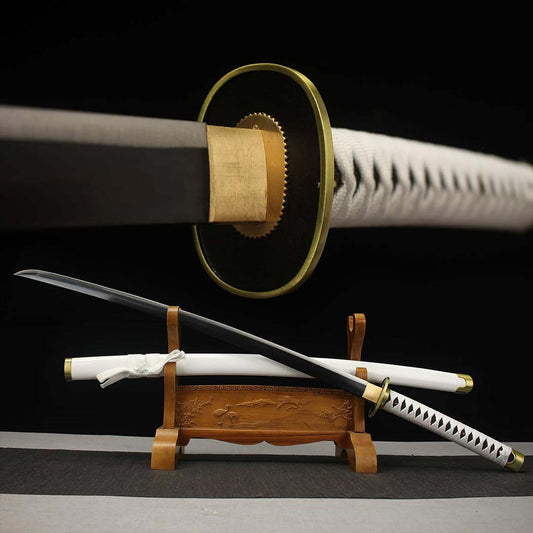
Jin Sakai Katana – Ghost of Tsushima Edition
This exceptional replica features 1060 carbon steel construction with traditional folding techniques that create distinctive hamon patterns. The 28-inch blade showcases the classic shinogi-zukuri geometry with a pronounced ridge line running the full length of the cutting surface.
- Hand-forged 1060 carbon steel with differential hardening creating visible hamon
- Full tang construction ensuring optimal balance and durability
- Authentic ray skin (same) wrapped handle with silk cord binding
- Traditional brass tsuba featuring cherry blossom motifs
- Complete with wooden scabbard (saya) finished in black lacquer
⭐⭐⭐⭐⭐ "Absolutely stunning craftsmanship! The balance is perfect and the hamon is gorgeous. Exactly what I wanted for my collection." - Marcus from Denver, Colorado
Shinobu Kocho Katana – Demon Slayer Edition
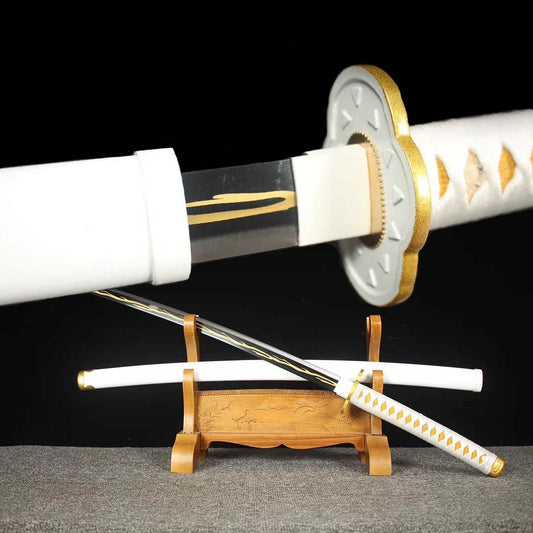
Inspired by the Insect Hashira's distinctive blade, this katana features unique purple and white color themes while maintaining traditional construction methods. The attention to anime accuracy combined with functional design makes this piece exceptional.
- 1060 carbon steel blade with custom purple-tinted finish
- Butterfly-inspired tsuba design with intricate metalwork details
- White silk handle wrapping over genuine ray skin
- 27-inch blade length optimized for quick-draw techniques
- Includes display stand and maintenance kit
⭐⭐⭐⭐⭐ "The purple finish is incredible and the butterfly details are perfect. Great quality steel that holds an edge beautifully." - Sarah from Austin, Texas
Kill Bill Katana Sword
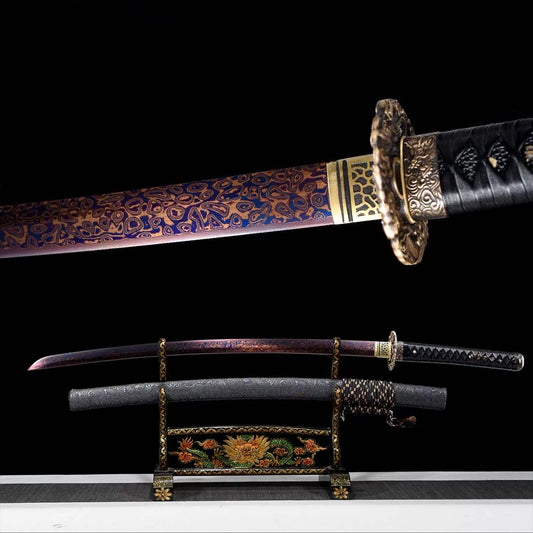
This iconic replica recreates the legendary Hattori Hanzo blade featured in Quentin Tarantino's films. The damascus steel construction provides both beauty and functionality for serious collectors.
- Damascus steel construction with distinctive wave patterns throughout blade
- Traditional yellow handle wrapping maintaining film accuracy
- 28-inch blade with razor-sharp edge geometry
- Full tang construction with proper weight distribution
- Comes with certificate of authenticity and care instructions
⭐⭐⭐⭐⭐ "This is exactly like the movie! The damascus patterns are beautiful and it's obviously high quality. Perfect for display or cutting practice." - James from Phoenix, Arizona
Michonne Katana Sword
Based on the iconic weapon from The Walking Dead series, this 1095 carbon steel katana offers exceptional cutting performance and durability. The design balances screen accuracy with practical functionality.
- 1095 high carbon steel providing superior edge retention
- Black cord-wrapped handle with textured grip surface
- 29-inch blade length ideal for two-handed techniques
- Includes leather shoulder strap for carrying
- Heat-treated to 58-60 HRC for optimal hardness
Michonne Katana – Premium Edition
Our premium version features upgraded materials and enhanced finishing techniques while maintaining the distinctive aesthetic that makes this weapon instantly recognizable to fans worldwide.
- Enhanced 1095 carbon steel with superior heat treatment
- Premium leather handle wrapping with brass fittings
- Hand-polished blade with mirror finish
- Upgraded wooden scabbard with brass reinforcements
- Collector's certificate with edition numbering
Black Blade Katana
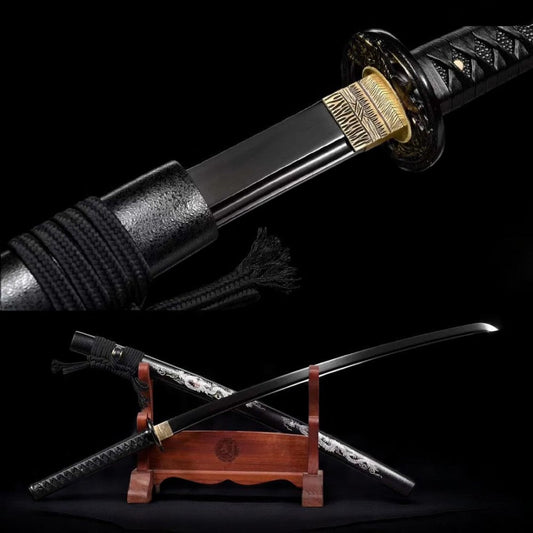
This striking piece features a dramatic black finish that doesn't compromise the underlying steel quality. The minimalist aesthetic appeals to collectors seeking modern interpretations of classical designs.
- 1060 carbon steel with protective black oxide coating
- All-black handle, guard, and scabbard for unified appearance
- 28-inch blade maintaining traditional curvature and geometry
- Excellent choice for both display and martial arts practice
- Includes basic maintenance supplies
When you unbox these swords, you'll immediately notice the substantial weight and perfect balance that distinguishes authentic construction from decorative pieces. Our anime katana collection continues expanding with new additions that maintain the same commitment to quality and historical accuracy.
For those seeking premium options, our high end collection features master-crafted pieces with superior materials and traditional construction techniques that approach museum-quality standards. Each weapon undergoes rigorous quality inspection to ensure it meets our exacting standards before reaching collectors.
Buyer's Guide for Collectors
Understanding what to look for when evaluating katana quality requires knowledge of steel types, construction methods, and quality indicators that separate authentic replicas from decorative pieces. Our decades of experience in the blade industry help American collectors make informed decisions about their investments.
Steel selection forms the foundation of any quality katana purchase. 1060 carbon steel offers excellent durability and edge retention for entry-level collectors, containing 0.60% carbon content that provides optimal hardness without excessive brittleness. This steel type accepts sharp edges easily and maintains them through regular use and display.
1095 carbon steel represents the premium choice for serious collectors and martial artists. With 0.95% carbon content, this steel achieves superior hardness (58-60 HRC) while requiring more careful maintenance to prevent corrosion. The higher carbon content enables thinner edge geometry and exceptional cutting performance.
Damascus steel construction creates distinctive wave patterns through folding and forge-welding multiple steel layers. While primarily aesthetic, quality damascus work indicates skilled craftsmanship and attention to detail that usually extends throughout the entire weapon's construction.
Full tang construction ensures proper balance and durability by extending the blade steel through the entire handle length. This method prevents handle separation during use and creates the authentic weight distribution that makes traditional katanas so effective in skilled hands.
Handle materials significantly impact both authenticity and functionality. Genuine ray skin (same) provides superior grip texture while silk or cotton cord wrapping offers comfort during extended handling. Synthetic materials may reduce cost but compromise the authentic feel that serious collectors desire.
Hamon visibility indicates proper differential hardening techniques where the blade edge receives different heat treatment than the spine. This creates the distinctive temper line that's both functional and beautiful, demonstrating traditional Japanese metallurgical knowledge.
When evaluating potential purchases, examine the point of balance carefully. Authentic katanas balance approximately 4-6 inches from the guard (tsuba), creating nimble handling characteristics. Poor reproductions often balance incorrectly due to improper weight distribution or inferior materials.
Edge geometry affects cutting performance dramatically. Look for blades with consistent taper from spine to edge, avoiding pieces with overly thick edges that won't cut effectively. The shinogi (ridge line) should run straight and true from the point to the guard without waves or irregularities.
Scabbard quality reflects overall attention to detail. Properly fitted wooden scabbards (saya) protect the blade while allowing smooth drawing motions. Loose-fitting scabbards damage blades through movement, while overly tight ones make drawing difficult and potentially dangerous.
For beginning collectors, our entry level collection provides excellent introduction to authentic construction methods without premium pricing. These pieces offer genuine 1060 carbon steel, proper geometry, and traditional fittings that teach appreciation for quality craftsmanship.
Advanced collectors often prefer our mid range collection featuring upgraded steel types, enhanced finishing, and superior attention to historical accuracy. These pieces bridge the gap between entry-level introductions and master-crafted heirlooms.
Remember that proper display and maintenance preserve your investment while ensuring safety. Quality katana stands position blades securely while showcasing their beauty, and regular cleaning prevents corrosion that can damage both steel and fittings permanently.
Why Choose Katana America
Every Katana America blade is made to order and hand-assembled in our partner workshops, then quality-checked before it ships. Count 3 to 4 weeks from your order to your door: 1 to 2 weeks of forging, then 1 to 2 weeks of tracked delivery. Prices are in US dollars, delivery is free on orders of $200 or more, and there are no customs fees to pay when your katana arrives. Collectors rate us 4.9/5 across 125+ verified reviews.
Our commitment to quality, customer service, and accessibility makes acquiring genuine replicas straightforward for American enthusiasts comparing different blade types.
No surprise duties, taxes, or fees appear after purchase—the price you see represents your complete investment in authentic Japanese craftsmanship.
Our team personally inspects every blade before processing, ensuring quality standards meet our exacting requirements. This additional quality control step prevents disappointments and reduces return rates, saving time and money for collectors seeking specific characteristics.
We maintain relationships with skilled craftsmen who understand American collector preferences while respecting traditional Japanese construction methods. This collaboration produces pieces that satisfy both authenticity requirements and practical considerations for US ownership and display.
Customer education remains a priority throughout your collecting journey. Our detailed product descriptions, maintenance guides, and historical information help collectors make informed decisions while developing appreciation for the artistry behind each piece.
Support services and repair assistance provide peace of mind for long-term ownership.
Our custom katana services allow personalization while maintaining traditional construction standards. Whether seeking specific dimensions, steel types, or aesthetic details, we coordinate with master craftsmen to create unique pieces reflecting individual preferences.
Legal compliance expertise ensures all products meet federal and state regulations for blade ownership and transport. We understand American knife laws and provide guidance for collectors navigating the complex patchwork of state and local regulations.
Evaluating these weapons becomes more meaningful when you can actually handle authentic examples rather than relying on theoretical knowledge alone. Our return policy allows hands-on evaluation, ensuring complete satisfaction with your investment in Japanese sword artistry.

Frequently Asked Questions
Q1: What makes an authentic katana different from a longsword for collectors?
Authentic pieces require traditional construction methods including differential hardening for katanas and proper steel composition for both weapon types. Look for visible hamon lines on Japanese blades, indicating genuine heat treatment techniques rather than etched decoration. Authentic katanas feature single-edged curved construction with traditional fittings like ray skin handles and wooden scabbards. Longswords should demonstrate straight double-edged geometry with appropriate crossguards and pommel designs. Steel quality matters tremendously—1060 or 1095 carbon steel provides authentic performance characteristics, while stainless steel indicates decorative rather than functional construction. Historical accuracy in proportions, weight distribution, and finish details separates museum-quality replicas from cheap imitations that disappoint serious collectors seeking genuine craftsmanship.
Q2: What steel type is best for katana collecting purposes?
For serious collecting studies, 1060 carbon steel offers the ideal balance of performance, durability, and affordability for most collectors. This steel contains 0.60% carbon content, providing excellent edge retention while remaining relatively easy to maintain. 1095 carbon steel represents the premium choice with 0.95% carbon content enabling superior sharpness and cutting performance, though it requires more careful maintenance to prevent rust. Damascus steel construction adds visual appeal through distinctive folding patterns but primarily serves aesthetic rather than functional purposes. Avoid stainless steel pieces entirely—while low-maintenance, they can't achieve the hardness levels necessary for authentic cutting performance. Spring steel works well for longsword reproductions, providing the flexibility needed for longer straight blades. Heat treatment quality matters more than raw steel type, so choose reputable manufacturers.
Q3: How do I properly maintain my katana collection?
Proper maintenance for your blade collection requires understanding each type's specific needs. Carbon steel katanas need regular oil application to prevent rust, using mineral oil or specialized sword oils. Clean blades immediately after handling to remove fingerprint oils and moisture. Store in dry locations with good air circulation, avoiding leather scabbards for long-term storage since leather can trap moisture. Longswords require similar care but can handle slightly more aggressive cleaning due to their homogeneous steel construction. Never use household cleaners, WD-40, or automotive oils that can damage steel or fittings. Inspect regularly for rust spots, addressing them immediately with fine abrasives and fresh oil. Professional restoration may be necessary for valuable pieces showing significant corrosion or damage. Learn proper handling techniques to avoid accidents and blade damage.
Q4: What size katana should I choose for my collection?
Size selection depends on intended use, storage space, and personal preferences. Standard katanas measure 28-30 inches blade length with 10-12 inch handles, creating overall lengths of 38-42 inches. Shorter wakizashi at 12-24 inch blade lengths suit smaller spaces and beginning collectors. Tanto knives under 12 inches provide entry-level options for those exploring Japanese blade design. Longswords typically measure 35-45 inches overall with proportionally longer blades relative to handles. Consider ceiling height, display case dimensions, and local regulations when choosing sizes. Longer blades offer more authentic historical proportions but require more storage space and careful handling. Many collectors start with mid-size pieces around 28 inches to balance authenticity with practicality. Remember that proper katana proportions maintain specific ratios between blade length, handle size, and overall balance.
Q5: How do I safely display my sword collection?
Displaying your collection requires balancing security, aesthetics, and blade preservation. Wall-mounted displays keep weapons accessible while preventing accidental contact, using padded brackets that support blades without pressure points. Horizontal displays reduce stress on mounting hardware compared to vertical arrangements. Keep blades away from direct sunlight that can fade handle wrapping and cause temperature fluctuations. Maintain consistent humidity levels between 40-50% to prevent rust without excessive dryness that can crack wooden components. Security considerations include locked display cases for valuable pieces and positioning that prevents easy theft access. Never display blades loose in stands where visitors might handle them unsupervised. Consider insurance coverage for valuable collections and photograph pieces for documentation purposes. Rotate displayed items periodically to prevent uneven fading and give your entire collection equal attention.
Q6: Is it legal to own a katana collection in the USA?
Owning a sword collection remains legal throughout the United States under federal law, though state and local regulations vary significantly. Most states allow ownership of historical replicas, antiques, and functional swords for collecting, martial arts practice, and display purposes. However, carrying laws differ dramatically between jurisdictions—what's legal to own may not be legal to transport or carry in public. Some cities restrict blade length, prohibit certain designs, or require permits for ownership. Educational institutions and workplaces often maintain separate policies prohibiting weapons regardless of legal ownership status. Research your specific state and local laws before purchasing, as ignorance doesn't provide legal protection. Consult local law enforcement or legal professionals for clarification on unclear regulations. Online resources and collector organizations provide general guidance but cannot replace professional legal advice for specific situations.
See the craft for yourself. Browse our hand-forged katana swords, forged in the Japanese tradition. Free U.S. shipping over $200, rated 4.9/5.
 Save $60