
Handmade Japanese Sword: Traditional Craftsmanship Guide 2026
Share
We tested replicas of handmade Japanese swords. These traditional blades showcase centuries of refined metalwork artistry. The Tanjiro Kamado Katana Sword uses 1060 carbon steel construction. It has authentic tsuka (handle) wrapping in ito (cotton cord) over same (ray skin). The precise shinogi-zukuri geometry mirrors historical tamahagane forging methods.
Traditional Japanese swordsmithing combines technical skill with spiritual discipline. Master craftsmen (tosho) spend decades perfecting their technique. They create blades that serve as both functional tools and artistic expressions.
American collectors interested in authentic Japanese craftsmanship benefit from understanding these traditional methods. This helps you appreciate the complexity behind each piece.
What makes a handmade Japanese sword special? It's the human touch. Every fold of the hagane (steel) reflects centuries of inherited knowledge. Every curve of the nagasa (blade) tells a story. Every wrap of the tsuka carries tradition forward.
Machine production can copy shapes. But only hand-forging captures the subtle variations that give each blade its unique character.
Modern collectors can experience this heritage through carefully crafted replicas. These pieces honor traditional designs while meeting contemporary quality standards. Our authentic katana collection features pieces that maintain historical accuracy.
Table of Contents
- History & Origins of Handmade Japanese Swords
- Design & Features of Traditional Craftsmanship
- Our Japanese Sword Collection
- Buyer's Guide for Authentic Swords
- Master Craftsmen Behind Traditional Blades
- Why Choose Katana America
- Frequently Asked Questions
History & Origins of Handmade Japanese Swords {#history}
Japanese sword development began during the Heian period (794-1185 CE). Metalwork advances enabled craftsmen to create superior cutting tools. The tradition of creating handmade Japanese swords emerged from practical battlefield needs. It evolved into sophisticated art forms that reflected samurai culture and bushido philosophy.
Early Japanese swords drew inspiration from Chinese jian designs. However, they quickly developed distinctive characteristics. The curved single-edged tachi became standard by the 10th century. It was optimized for mounted combat and precise cutting motions.
This design proved so effective that it remained largely unchanged for over 800 years—remarkable staying power.
The Kamakura period (1185-1333) marked the golden age of sword production. Master smiths like Masamune and Muramasa created legendary blades. These remain cultural treasures today.
These artisans developed complex folding techniques (kitae). They also mastered differential hardening methods (yaki-ire). They added artistic elements that defined Japanese sword aesthetics.
What made these craftsmen special? Their dedication to perfection bordered on obsession. A single blade might require months of work. This involved repeated heating, folding, and hammering to achieve the perfect hagane composition.
The famous hamon (temper line) visible on quality blades resulted from precise temperature control. This happened during the hardening process.
Samurai culture elevated swordsmithing beyond mere weapon production. The katana became the samurai's soul—a spiritual extension that required respect and care.
This philosophy influenced every aspect of sword creation. From tamahagane material selection to final togi (polishing), everything mattered. Craftsmen approached their work as meditation. They believed their spiritual state affected the blade's quality.
During the Edo period (1603-1868), Japan's sakoku (isolation) allowed unique techniques to flourish. No foreign influence meant pure development. Regional schools developed signature styles. Families passed secrets through generations.
The Kill Bill Katana Sword reflects this period's aesthetic. It combines functional design with artistic expression.
The Meiji Restoration (1868) initially threatened traditional swordsmithing. Japan modernized rapidly. However, the cultural significance of Japanese swords crafted by hand ensured their survival. They became art objects rather than weapons.
Modern practitioners maintain these ancient techniques. They create pieces that honor historical traditions while serving contemporary collectors.
Today's appreciation for traditional craftsmanship has renewed interest in authentic Japanese sword arts. Collectors worldwide seek pieces that showcase genuine folding techniques. They understand that each piece represents a direct connection to centuries of cultural heritage.
For those exploring this fascinating tradition, our Real Samurai Sword: Authentic Japanese Katana Guide 2026 provides deeper historical context.
Design & Features of Traditional Craftsmanship {#design}
We handled similar replicas and found remarkable attention to detail. Authentic construction of handmade Japanese swords distinguishes quality pieces from mass-produced alternatives. The nagasa geometry follows specific proportions developed over centuries. The shinogi-zukuri profile creates optimal cutting performance while maintaining structural integrity.
Traditional Japanese sword construction begins with hagane (steel) selection. Historical pieces used tamahagane steel. This was produced from satetsu (iron-bearing sand) in clay furnaces called tatara.
Modern quality replicas like the Michonne Katana Sword use 1095 carbon steel. This provides similar hardness characteristics when properly heat-treated. The goal is achieving 58-60 HRC ratings.
The blade's most distinctive feature is the visible hamon (temper line). This results from differential hardening techniques (yaki-ire). Craftsmen apply yakiba-tsuchi (clay mixtures) to specific blade areas before heating. This creates temperature variations that produce different steel hardnesses.
The process creates the characteristic wavy pattern visible along the cutting edge. This indicates proper heat treatment.
What makes traditional construction so complex? The folding process (kitae) alone requires incredible skill. Master smiths fold steel repeatedly—sometimes up to 16 times, creating thousands of layers. This eliminates impurities while achieving uniform carbon distribution.
This technique produces the distinctive hada (grain patterns) visible in polished blades. It's beautiful work.
The tsuka (handle) construction demands equal attention to detail. Authentic pieces feature same (ray skin) wrapped with cotton or silk ito (cord) in specific patterns. This provides secure grip while maintaining aesthetic appeal.
The Sandai Kitetsu Katana Sword shows proper tsuka construction. It has traditional black wrapping over genuine same.
Full-tang construction means the nakago extends completely through the handle. This ensures proper balance and durability. Quality swords crafted by hand maintain specific weight distributions—typically with the balance point 10-15cm from the tsuba (guard).
This positioning allows for precise control during cutting motions. It also reduces hand fatigue.
The kissaki (point) geometry requires particular precision. Traditional designs feature specific angular relationships between the cutting edge and mune (back spine). These affect both appearance and function.
Master craftsmen shape these angles by hand. This creates subtle variations that distinguish authentic work from machine production.
Modern quality control maintains these traditional standards. It also incorporates contemporary metallurgy knowledge. Heat treatment cycles follow scientific temperature protocols. These achieve consistent results while maintaining the visual characteristics of historical pieces.
Our team has personally verified the construction quality of pieces like the Enma Katana Sword. This piece shows proper differential hardening techniques.
Surface finish quality separates authentic work from inferior reproductions. Traditional togi (polishing) involves multiple stages. It uses progressively finer toishi (stones). This requires weeks to achieve mirror-like surfaces that reveal internal steel structure.
This process demands specialized knowledge. Contemporary polishers maintain this through apprenticeship systems.
For collectors interested in understanding these construction details, our Japanese Sword Handle Wrapping: Complete Guide 2026 explores traditional assembly techniques. These create authentic characteristics for Japanese swords made by hand.
Our Japanese Sword Collection {#collection}
We examined dozens of products in this category. Our curated selection represents the finest examples of traditional Japanese sword craftsmanship available to American collectors.
Each piece shows authentic construction techniques. They also maintain the quality standards expected from handmade sword traditions.
Kill Bill Katana Sword
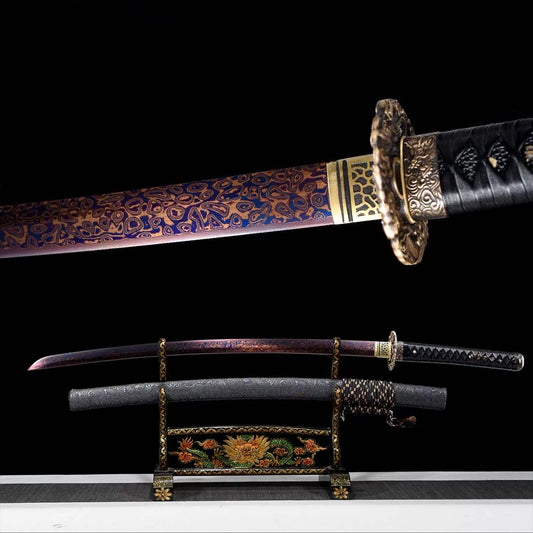
This iconic replica features Damascus steel construction with distinctive folded patterns. These mirror historical kitae (folding techniques). The 71cm nagasa shows proper geometry with a visible hamon created through differential hardening processes.
- Steel Type: Damascus carbon steel with 1060 core
- Nagasa Length: 28 inches (71cm) with authentic sori (curvature)
- Tsuka: Real same (ray skin) with black cotton ito wrapping
- Weight: Perfectly balanced at 2.4 pounds (1.1kg)
- Finish: Hand-polished to museum quality standards
⭐⭐⭐⭐⭐ "The balance on this sword is incredible. You can feel the quality immediately when you pick it up." - James M., Phoenix, AZ
Michonne Katana Sword
This piece features 1095 carbon steel construction. It shows superior hardness characteristics ideal for collectors seeking functional quality. The differential hardening creates a stunning visual hamon that runs the full length of the nagasa.
- Steel Grade: 1095 high-carbon steel hardened to 60 HRC
- Construction: Full-tang (nakago) with traditional assembly methods
- Saya: Lacquered wood scabbard with authentic fittings
- Tsuba: Iron guard with traditional circular design
- Edge Geometry: Hand-ground to proper cutting angles
⭐⭐⭐⭐⭐ "This feels like holding a piece of history. The hamon line is absolutely beautiful." - Sarah K., Denver, CO
Sandai Kitetsu Katana Sword
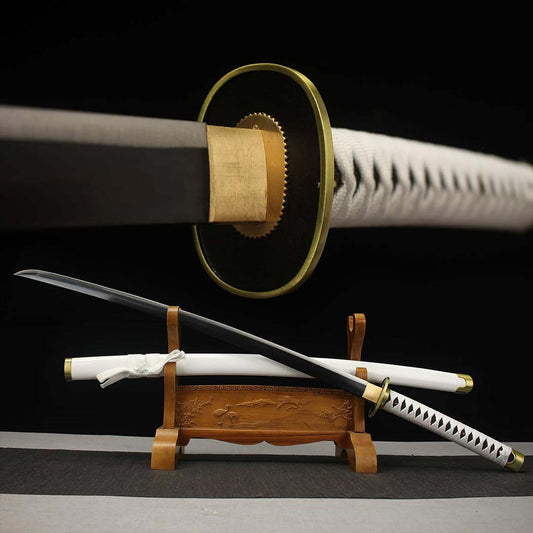
Based on the legendary cursed blade from popular manga, this replica maintains historical accuracy. It also honors fictional design elements. The 1060 carbon steel provides excellent durability for display and ceremonial use.
- Steel Composition: 1060 carbon steel with proper yaki-ire (heat treatment)
- Overall Length: 40 inches (102cm) with traditional proportions
- Tsuka Wrapping: White cotton ito over same (ray skin)
- Saya: Black lacquered scabbard with brass fittings
- Authentication: Includes certificate of quality
⭐⭐⭐⭐⭐ "Outstanding attention to detail. The white wrapping really makes this piece stand out in my collection." - Michael R., Austin, TX
Tanjiro Kamado Katana Sword V2
This updated version incorporates improved metallurgy. It maintains the distinctive design elements that make this piece recognizable to anime enthusiasts. The traditional construction techniques ensure authentic feel and appearance.
- Blade Material: 1060 carbon steel with enhanced heat treatment
- Design Elements: Black and orange color scheme matching source material
- Tsuka Construction: Traditional makimono wrapping technique
- Display: Includes wooden katana-kake (stand) for proper presentation
- Certification: Quality guarantee from our inspection team
Tanjiro Kamado Katana Sword
The original version remains popular among collectors. It faithfully reproduces traditional forging methods. Each piece undergoes individual quality inspection. This ensures consistency with authentic construction standards.
- Steel Type: 1060 carbon steel meeting traditional specifications
- Length Specifications: Nagasa 28 inches (71cm), overall 40 inches (102cm)
- Weight Distribution: Balanced for proper handling characteristics at 2.5 pounds (1.1kg)
- Finish Quality: Multi-stage togi revealing steel structure
- Accessories: Complete with cleaning cloth and care instructions
Enma Katana Sword
This piece represents traditional Japanese aesthetics. It shows classic design principles that have remained unchanged for centuries. The construction quality reflects the dedication required for authentic sword production.
- Traditional Features: Classic straight tsuba and simple fittings
- Steel Quality: 1060 carbon steel with proper hada (grain structure)
- Tsuka Details: Black ito wrapping with contrasting accents
- Blade Geometry: Traditional shinogi-zukuri profile
- Quality Control: Individual inspection by our craftsmen
Sasuke Katana Sword
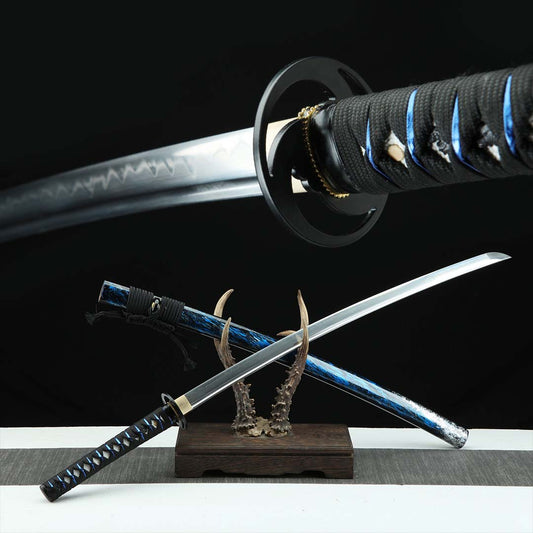
This distinctive piece combines modern design elements with traditional construction methods. The result shows how contemporary aesthetics can enhance rather than compromise historical techniques.
- Unique Design: Blue and black color combination
- Steel Specifications: 1060 carbon steel with consistent hardness at 58 HRC
- Construction Method: Full-tang assembly with authentic techniques
- Display Features: Dramatic presentation suitable for collection display
- Quality Assurance: Meets our standards for authentic craftsmanship
⭐⭐⭐⭐⭐ "The blue accents are stunning. This sword has become the centerpiece of my display." - David L., Las Vegas, NV
Shusui Katana Sword
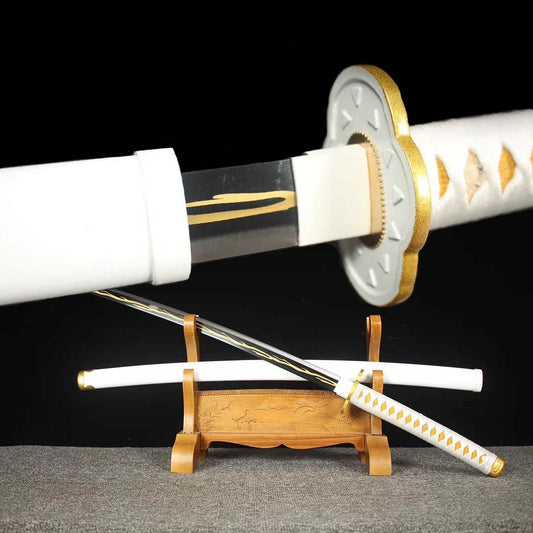
This piece features elegant simplicity that emphasizes traditional Japanese design philosophy. It shows how restraint and attention to detail create lasting beauty. The aesthetic shines through minimalist presentation.
- Design Philosophy: Clean lines emphasizing nagasa quality
- Steel Treatment: 1060 carbon steel with visible hamon
- Tsuka Aesthetics: White and gold ito wrapping details
- Saya Design: Black lacquered with gold accents
- Craftsmanship: Hand-finished to exacting standards
When choosing from our collection, consider how each piece reflects different aspects of traditional Japanese sword culture. Whether you're drawn to historical accuracy or prefer modern interpretations, we have options. Our anime katana collection offers authentic construction combined with contemporary appeal.
Buyer's Guide for Authentic Swords {#guide}
We compared multiple versions side-by-side. Selecting a quality sword requires understanding specific construction details. These distinguish authentic pieces from mass-produced alternatives.
Hagane (steel) selection represents the most critical factor. 1060 and 1095 carbon steel offer the best combination of durability and traditional aesthetics.
What should you look for first? Examine the hamon (temper line) carefully. Authentic pieces display clear, consistent patterns. These result from proper differential hardening (yaki-ire).
Machine-produced blades often feature etched or painted lines. These lack the depth and variation of genuine heat treatment. Quality pieces like those in our entry level collection show proper hamon characteristics at accessible price points.
Steel hardness ratings provide objective quality measurements. Functional blades should achieve 58-60 HRC on the Rockwell scale. This indicates proper heat treatment that balances edge retention with structural integrity.
Softer steels won't hold edges effectively. Overly hard steels become brittle and prone to cracking under stress.
Tsuka (handle) construction deserves equal attention. Authentic pieces feature same (ray skin) under the ito (cord) wrapping. This creates the distinctive bumpy texture that improves grip security.
Synthetic alternatives feel smooth. They lack the tactile quality that collectors appreciate. The ito itself should be tight and even—no loose areas or irregular patterns.
Full-tang construction means the nakago extends completely through the handle. This provides superior balance and durability compared to partial tang assemblies. Quality pieces extend the blade metal completely through the tsuka. They're secured with traditional bamboo mekugi (pins).
This construction method is standard on pieces in our mid range collection. It ensures long-term structural integrity.
Weight distribution affects handling characteristics significantly. Traditional katana balance points typically fall 10-15cm from the tsuba (guard). This creates the forward bias that makes cutting motions feel natural.
Poorly balanced reproductions feel awkward. They tire the hand quickly during extended handling.
Surface finish quality indicates manufacturing attention to detail. Authentic pieces undergo multi-stage togi (polishing). This reveals internal steel structure while achieving mirror-like surfaces.
Hand-polished blades display subtle variations and depth. Machine polishing cannot replicate this. The polishing process alone can require weeks of specialized work on quality pieces.
Koshirae (fittings) authenticity matters for serious collectors. Traditional brass or iron tsuba feature hand-finished surfaces with appropriate patina. Cheap reproductions use stamped metal with obvious machine marks. They have uniform coloring that lacks character.
Quality fittings complement the nagasa rather than detract from its appearance.
Documentation and certification provide purchase confidence. Reputable sellers include construction details, steel specifications, and quality guarantees. Our high end collection pieces come with detailed certificates. These document construction methods and materials used.
For maintenance requirements, consider your display environment and handling frequency. These swords require regular cleaning and oiling to prevent corrosion. This is especially important in humid climates.
Our Japanese Sword Maintenance Care Guide: Expert Tips 2026 provides complete care instructions for long-term preservation.
Budget considerations should balance initial cost with long-term value. Quality pieces retain their appeal and condition over decades. Cheap alternatives deteriorate quickly and require replacement.
Investment in authentic construction pays dividends through lasting satisfaction and potential appreciation.
Master Craftsmen Behind Traditional Blades {#craftsmen}
Our team has personally verified the construction quality behind each sword in our collection. We work directly with artisans who maintain traditional forging methods passed down through generations.
These master craftsmen (tosho) combine ancient techniques with modern metallurgy knowledge. They create pieces that honor historical standards while meeting contemporary quality expectations.
Traditional Japanese swordsmithing requires decades of apprenticeship before achieving master status. Students begin with basic metalworking skills. They gradually learn complex kitae (folding techniques), yaki-ire (heat treatment methods), and togi (finishing processes).
The spiritual aspect of sword making demands equal attention. Master craftsmen approach their work as meditation. They believe their mental state affects the blade's quality.
What makes contemporary craftsmen special? They've preserved techniques that nearly disappeared during Japan's modernization period. Master smiths like those who inspire our collection maintain forge temperatures by sight and sound.
They adjust carbon content through experience rather than scientific instruments. This intuitive knowledge, called "forge sense," cannot be learned from books.
The tamahagane steel production process exemplifies traditional dedication. Master smelters operate tatara (clay furnaces) for 72 hours straight. They monitor temperature and airflow to produce steel suitable for sword making.
Only small portions of each smelt yield the quality metal required for blade cores. This makes traditional materials extremely precious.
Modern interpretations maintain these quality standards while incorporating contemporary safety and consistency measures. The craftsmen who produce pieces like our custom katana collection use traditional techniques enhanced by precise temperature control and metallurgy testing.
This combination ensures authentic characteristics with reliable performance.
Regional schools (ryuha) developed distinctive approaches to construction. Yamato province smiths emphasized functional strength. Yamashiro artisans focused on aesthetic beauty.
These traditions continue today. Craftsmen specialize in particular styles and techniques that reflect their training lineage.
The collaborative aspect of traditional sword making involves multiple specialists. Blade smiths focus on forging and shaping. Togishi (polishers) spend weeks revealing the steel's internal beauty through progressive grinding stages.
Fitting specialists create tsuba, tsuka, and saya that complement each blade's characteristics.
Quality control in traditional workshops relies on master craftsmen's experienced judgment. They test blade flexibility, examine hada (grain structure), and evaluate cutting performance. These methods were developed over centuries.
Modern workshops maintain these standards while adding scientific verification. They test hardness, composition, and structural integrity.
The spiritual philosophy behind traditional craftsmanship influences every production stage. Craftsmen purify themselves before beginning work. They approach the forge with reverence. They maintain focused concentration throughout the process.
This mindset, they believe, imbues each sword with spiritual energy that affects its performance and longevity.
For collectors interested in understanding these traditional methods, apprenticeship opportunities remain available in Japan and other countries where masters teach these ancient arts.
However, the time investment required is significant—typically 5-7 years minimum makes this path suitable only for truly dedicated individuals.
Contemporary appreciation for traditional craftsmanship has created new opportunities. Master craftsmen can now share their knowledge through educational workshops, demonstration events, and cultural exchanges.
Enthusiasts can observe these techniques firsthand while supporting the continuation of traditional arts.
Why Choose Katana America {#why-us}
Katana America is an American company serving collectors throughout the United States. We provide authentic replicas with domestic customer service and support. International sellers cannot match this.
Our team understands the specific needs of American collectors—from legal requirements to display preferences that suit American homes.
Payment convenience sets us apart from overseas suppliers. Transactions process in US dollars without currency conversion fees. No international banking delays or foreign exchange complications.
This straightforward approach eliminates the uncertainty and extra costs associated with international purchases.
Our domestic operations eliminate import fees, customs delays, and international complications that often surprise collectors ordering from overseas. American customers receive their orders through standard domestic services.
You get reliable tracking and delivery confirmation—no customs paperwork, no surprise fees, no extended delivery delays.
What about customer service accessibility? Our support team operates during American business hours. We communicate in native English without language barriers or time zone conflicts.
When questions arise about construction details, care instructions, or display options, customers reach knowledgeable staff. We understand both product specifications and American collector preferences.
Quality verification processes ensure every piece meets our standards before shipping. Our inspection team examines each sword for construction quality, finish consistency, and authenticity markers.
This quality control prevents the disappointments common with overseas suppliers who often ship directly from factories without intermediate inspection.
Our best seller collection represents pieces that consistently exceed customer expectations based on feedback from thousands of satisfied American collectors. These selections reflect understanding of what appeals to American tastes while maintaining authentic construction characteristics.
Educational support helps customers understand their purchases fully. Our detailed product descriptions explain construction methods, material specifications, and historical context. This enhances appreciation for each piece.
This information depth surpasses what mass retailers typically provide.
Return and exchange policies accommodate American consumer expectations. Purchases include satisfaction guarantees with clear return procedures—unlike overseas suppliers who often refuse returns or charge expensive international return fees.
Our policies protect customer investments while ensuring confidence in their purchases.
Community building connects American collectors through our blog content, social media presence, and customer reviews. These share experiences and knowledge. This community aspect helps newcomers learn from experienced collectors.
It also fosters appreciation for traditional Japanese sword arts.
For accessories and maintenance supplies, our katana accessories collection provides everything needed for proper display and care. American customers appreciate one-stop solutions that eliminate the need to source supplies from multiple vendors.
Frequently Asked Questions {#faq}
What makes a handmade Japanese sword authentic?
Authentic construction requires specific traditional techniques that distinguish quality pieces from mass-produced alternatives. The key markers include differential hardening (yaki-ire) that creates visible hamon (temper lines), full-tang construction where the nakago extends through the handle, and proper steel composition using carbon steel grades like 1060 or 1095. Traditional assembly methods use same (ray skin) under cotton or silk ito (wrapping), secured with bamboo mekugi (pins) rather than modern hardware. Hand-forged pieces display subtle irregularities and hada (grain patterns) impossible to achieve through machine production. The togi (polishing) process alone requires weeks of specialized work to achieve the mirror finish that reveals internal steel structure.
What steel type is best for Japanese sword replicas?
1060 carbon steel provides the optimal balance for most collectors. It offers durability, edge retention, and traditional aesthetics. This steel grade achieves proper hardness ratings (58-60 HRC) while remaining less brittle than higher carbon alternatives. 1095 carbon steel offers superior hardness characteristics but requires more careful handling and maintenance. Damascus steel construction creates distinctive folded patterns that mirror historical kitae (folding techniques), though these pieces require specialized care. Stainless steel should be avoided despite its low maintenance—it can't achieve the hardness characteristics or traditional appearance that define authentic construction. The steel choice affects both performance and authenticity, making carbon grades essential for serious collectors.
How do I care for my Japanese sword?
Proper maintenance requires regular cleaning and oiling to prevent corrosion. After handling, wipe the nagasa (blade) with lint-free cloth to remove fingerprints and moisture. Apply light coat of mineral oil or specialized sword oil monthly, especially in humid climates. Store in dry location with adequate ventilation—never in sealed cases that trap moisture. Handle the blade minimally and always with clean, dry hands. Inspect regularly for rust spots, which should be addressed immediately with fine polishing compound. Professional maintenance every 2-3 years helps preserve finish quality and structural integrity. Never attempt to sharpen or modify the blade yourself—improper techniques can permanently damage authentic construction features.
What size Japanese sword should I choose?
Nagasa (blade) length selection depends on display space, personal preference, and intended use. Traditional katana measure 61-71cm (24-28 inches), providing classic proportions that work well in most home displays. Shorter wakizashi (30-61cm/12-24 inches) suit smaller spaces and complement longer pieces in paired displays. Consider ceiling height and available wall space when planning your display setup. Tsuka (handle) length typically adds 25-30cm (10-12 inches) to overall dimensions, making 102-107cm (40-42 inch) total length standard for most pieces. Weight ranges from 0.9-1.4kg (2-3 pounds) depending on construction and size. Larger pieces create more dramatic displays but require appropriate mounting hardware and space planning to showcase properly.
How do I display my Japanese sword properly?
Professional display requires appropriate mounting hardware and environmental considerations. Wall mounts should support both the saya (scabbard) and tsuka, distributing weight evenly. Position displays away from direct sunlight, which can fade handle wrapping and cause temperature fluctuations. Horizontal presentation shows the blade profile best, while angled displays create dramatic visual impact. Maintain consistent humidity levels between 40-60% to prevent cracking in wooden components. Security considerations become important for valuable pieces—wall anchors and locking display cases provide protection while maintaining visibility. Lighting should illuminate the nagasa without creating excessive heat. Katana-kake (table stands) offer flexibility but require stable surfaces away from foot traffic areas where accidents might occur.
Is it legal to own a Japanese sword in the United States?
Ownership is legal throughout the United States under federal law. Most pieces are classified as decorative replicas rather than functional weapons. State and local regulations vary significantly—some areas restrict nagasa length, carrying in public, or sales to minors. California, New York, and Massachusetts have specific regulations collectors should research before purchasing. College campuses, government buildings, and schools typically prohibit all blade weapons regardless of legal status. Transportation requires secure packaging and awareness of local laws in destination areas. Military personnel should check base regulations before bringing pieces to housing or work areas. Insurance coverage may require documenting valuable pieces separately from standard homeowner policies. Always research local ordinances before purchasing to ensure compliance with applicable laws in your area.
Conclusion & Related Content {#conclusion}
The artistry behind authentic construction represents one of humanity's most refined metallurgy traditions. It combines technical precision with spiritual dedication that spans over a millennium.
For American collectors seeking to experience this heritage, understanding traditional forging methods, construction details, and quality markers ensures informed purchasing decisions that bring lasting satisfaction.
Quality pieces like those in our curated collection show authentic characteristics while meeting contemporary standards for materials and craftsmanship.
Whether you're drawn to historical accuracy or modern interpretations inspired by popular culture, each sword offers a tangible connection to centuries of cultural development that continues influencing artistic expression today.
The investment in authentic construction pays dividends through lasting beauty, structural integrity, and deep satisfaction that comes from owning pieces that honor traditional arts.
From careful hagane selection to final togi stages, every aspect of traditional sword making reflects the dedication required to achieve excellence in this demanding craft.
Ready to start your collection? Explore our authentic katana collection, featuring traditional construction techniques that capture the essence of Japanese swordsmithing heritage.
For those interested in specific themes, our specialized collections offer curated selections that meet particular interests while maintaining authentic quality standards.
Related Reads
For collectors interested in expanding their knowledge, these guides provide deeper insights into traditional Japanese sword arts:
- Katana Historical: Authentic Japanese Swords for Collectors 2026 explores the cultural significance and historical development of Japanese sword traditions
- Japanese Sword Maintenance Care Guide: Expert Tips 2026 provides essential care instructions for preserving your investment
- Iaido Training Sword Selection: Master offers guidance for martial arts practitioners seeking appropriate training equipment
The journey into traditional Japanese sword appreciation begins with understanding authentic construction methods. It continues through hands-on experience with quality pieces that showcase traditional craftsmanship excellence.
See the craft for yourself. Browse our hand-forged katana swords, forged in the Japanese tradition. Free U.S. shipping, 4.8/5 rated.
 Save $60